Reflecting at Harvest Time

I didn’t grow this cauliflower although I would love to say I had. It is organically, locally grown but not in my backyard.

But I DID grow these sweet potato cubes! See:

(Contents: ground turkey with fennel, onion, cauliflower, and golden berries, seasoned with salt, coriander and Garam Marsala.)

Every year I learn something new. And or I have a mysterious success in my veggie growing journey. I worked hard for the two or three sweet potatoes that I harvested last week — getting the slips started, potting then transplanting them.   but I failed to mulch them and feed them and water then enough once they were established.

Or, maybe I over fed them? this year every plant in the garden grew tremendous amounts of leaves and renegade volunteer pumpkin plants took possession, in a tidal wave of four foot high prickly greenery! until Edward beat it back.

Lucky thing our family isn’t counting on my growing to eat. On the other hand, hunger might incentivize faster learning…

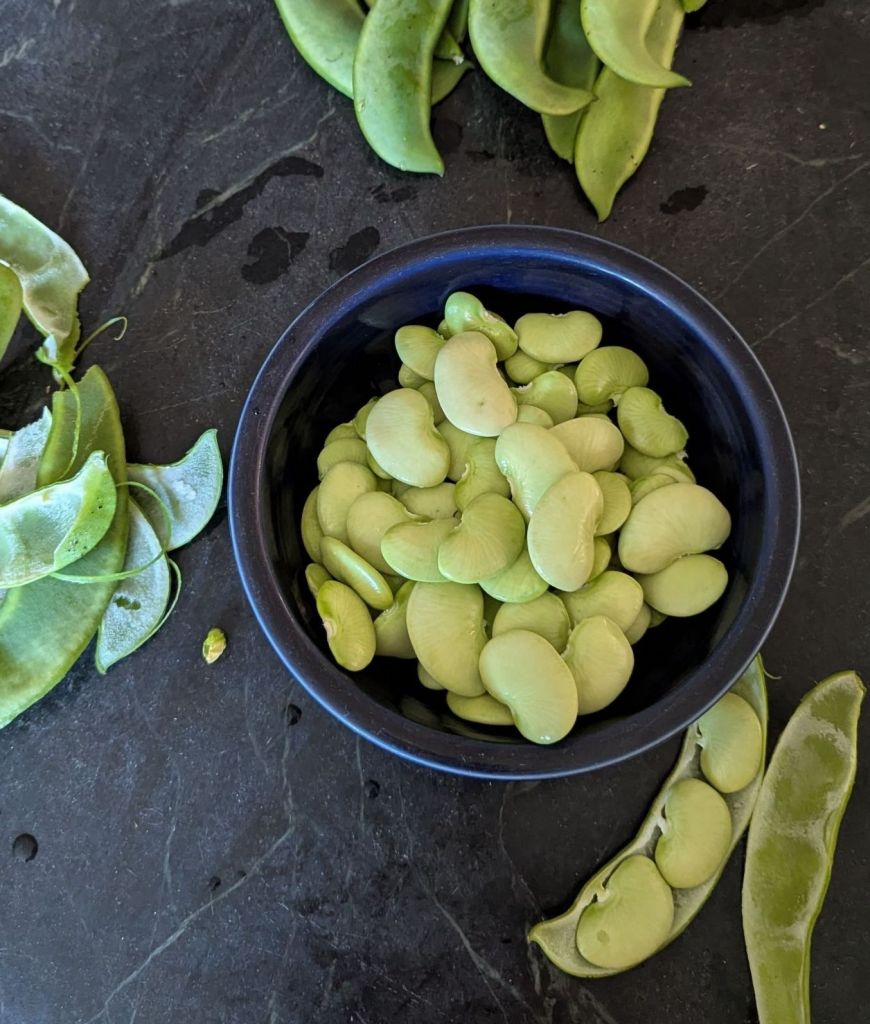
Our first time ever harvesting Lima beans

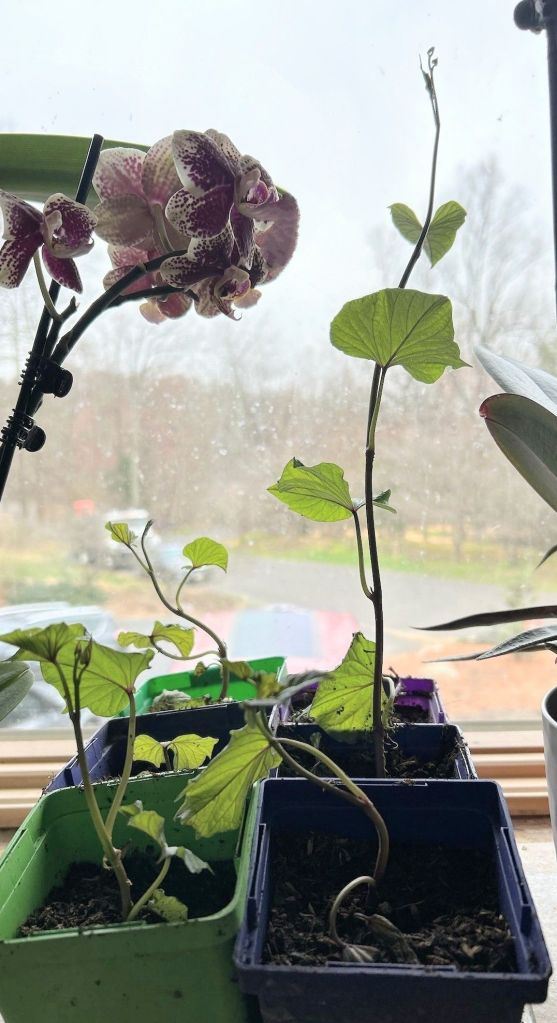
But back to the sweet potatoes. Remember the slips? Growing like hair on top of the potato stuck in water? Well, they grew great huge plants. Everything was GREAT AND HUGE this year. I thought we would get TONS of potatoes.The videos I watched said “just one potato grows tons… ”

When I dug them out it was late in the season, the signal purple flowers told me long before that a harvest should be there. But under the masses of leaves (too much nitrogen ??) on the first plant there’s was nothing but skinny little potato fingers. Poop! For the second year in a row!  I yanked the enormous, worthless, leafy mass out and threw it on the compost pile, growling. 

I went to pull the other enormous worthless plant out and — WHAT! lo and behold, there were two big sweet potatoes!!! Some critter had found them before me and started gnawing on them. In fact they were sticking out of the ground, chewed. Sadly, no photo. You will have to believe me.

I certainly still have things to learn about sweet potatoes. And I plan to learn them. There are two things that inspire me. One is failure. Don’t tell me I can’t do it! And the other is success.

2026, here we come.

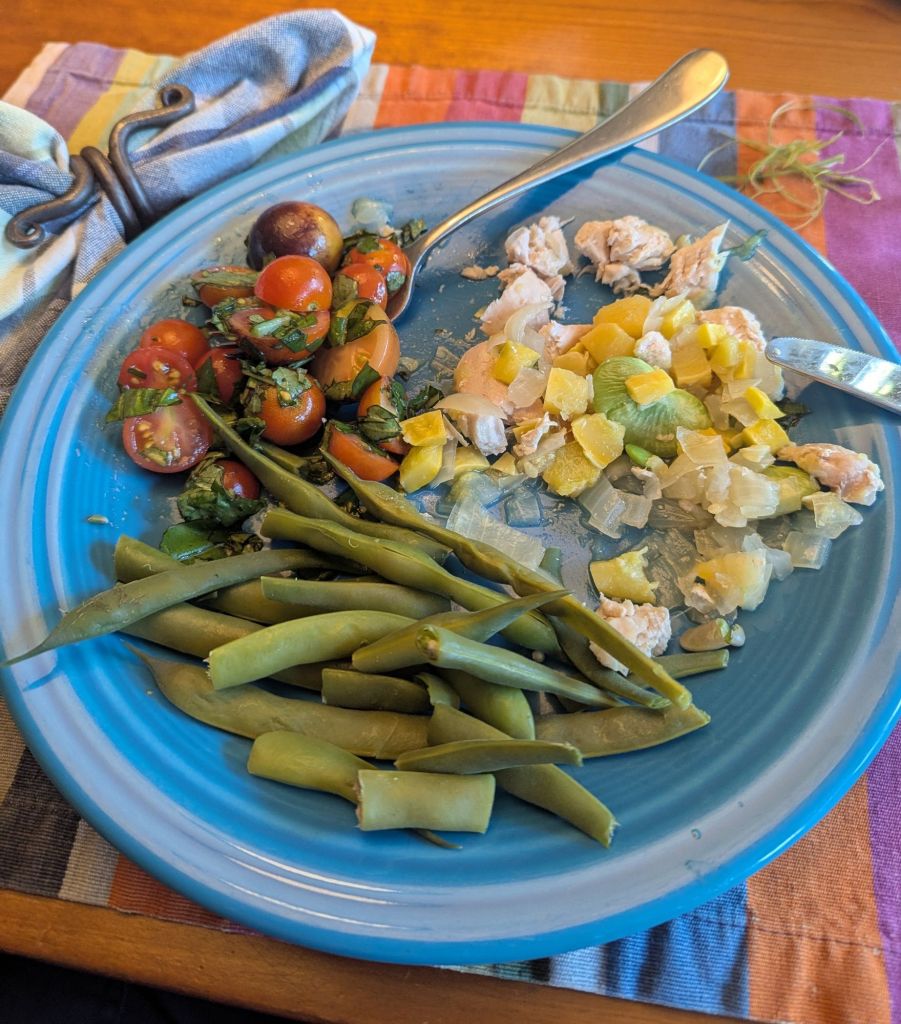
Summer meal of success: homegrown tomatoes, basil, green beans, and summer squash.

Fruit Harvest?…

Last week’s yield from our gardens…Don’t open your fruit stand yet.

Damned squirrels. They can be blamed for the single peach– our fruit trees were loaded this spring! I know it sounds like the proverbial one-that-got away story. I should have taken photos!  Those little trees did produce handsomely, and the squirrels enjoyed the hard, unripened fruit down to the pits, which they left all over under the maple at the back of the property. Little gnawed peach pits, presumably as a thank you gift. Or as a marker: “Yo. Adrian. I was here.”  Or possibly a rude squirrel hand gesture.

Anyway, the blueberries are netted (HAH- HAH- HAH so there) which means I can’t blame squirrels nor birds for the palky production. It’s just the bushes aren’t up to speed yet. Still. Maybe the soil’s not right? One bed’s soil wasn’t seasoned a year before being planted, as it’s recommended. And last year’s drought probably slowed some of the root growth down. Our PA blueberry growing has been challenging.

Once we DID have a blueberry bush that REALLY produced (I sound like bad King John) but then our neighbors put up a solid, bright white plastic fence and besides I foolishly planted a water-hogging mulberry too close… And that finished that mama bush off. Edward has a saying: “The hated mulberry.” He has a low opinion of all mulberries. The nursery said the mulberry was a dwarf. It was supposed to keep the birds away from the blueberries. Edward was very nice about being right and didn’t rub it in.

And this week’s single strawberry. Sigh. Well,  I purchased those plants frivolously from the grocery store, with no particular plan, and planted them at the edge of the blueberry bed. They are doing great! Spreading beautifully. Blueberries and strawberries like the pine needly soil there. These strawberries are everbearing apparently, so they don’t have one big crop, but produce sporadically all summer. However, the blueberries behind them are not doing great this year. I do wonder if this is a repetition of the mulberry scenario…

Or of the strawberry/rhubarb saga. I tried growing strawberries under rhubarb once as companion plants, and  to suppress weeds– and found that the strawberries charged forward, hogging too much of the soil nutrients. My rhubarb didn’t consider them good company.

The moral of the story: fruit can be hard to grow. I just never get tired of trying! Why? Because the two peaches that we’ve eaten from our trees are the best tasting peaches that I’ve had this summer. Same for the strawberries – very good flavor. And the blueberries that Mama blueberry bush used to make (back in the MD garden) were some of the best tasting blueberries. You simply can’t beat food for taste or nutrition that comes right off the branch or vine into your kitchen. ♥️

Mulberries harvested from the wild —
At the edge of the fields waayyy behind our gardens

‘Scape Into the Sun!

This year’s garlic, revealed

Or — ‘scape from the humidity, depending on how you feel. After what feels like weeks of rain ( was it only days?) the sun has come out today and it’s heating up.  Time to pull the garlic!

Garlic is planted around Halloween, winters over under a warm blanket of mulch, and is pulled out and cured in the very early summer sun

These are the largest garlics I’ve ever grown. Missing is a photo of me flat on my keester after trying to pull out one that didn’t wanna let go of the nice moist soil. Why are they so gorgeous this time?  Dunno! – some combination of the soil, (this plot has been resting?) or extra rain? or perhaps the particular garlic cloves that I planted back in the fall? I am not picky, I use whatever the organic grocery store has to offer that week, and that means I never know exactly what I’m planting.

Garlic scapes

These gorgeous curling structures are called scapes and I’ve never had so many on my garlic before. I suspect it means that the garlic should have been harvested sooner, and some of the garlicky essence is ‘scaping…. Ah well, just eat ’em. What can you do? Last week I was traveling, since then it’s been raining.

Once you’ve pulled the garlic out, and knocked off the extra soil, you peel off a couple leaves to reveal the clean under-surface.  Then the garlic has to cure in the hot sunshine for 2 weeks. So get ready to run out and tarp it over whenever it rains — and then whip the tarp off again!  Once cured, it will last a pretty long time… If you don’t eat it up first!

Note the volunteer red oak seedlings…

Save some of the biggest cloves to plant in the fall again. I’ve been told if you keep the seeds from the best of your produce, and plant it, again and again, you will create a line of produce that prefers your microclimate! ♥️

Renewed and Reborn

Two Doc Martins exploding in slo mo

It was early April when I started limas, which is too late but I thought, why not?

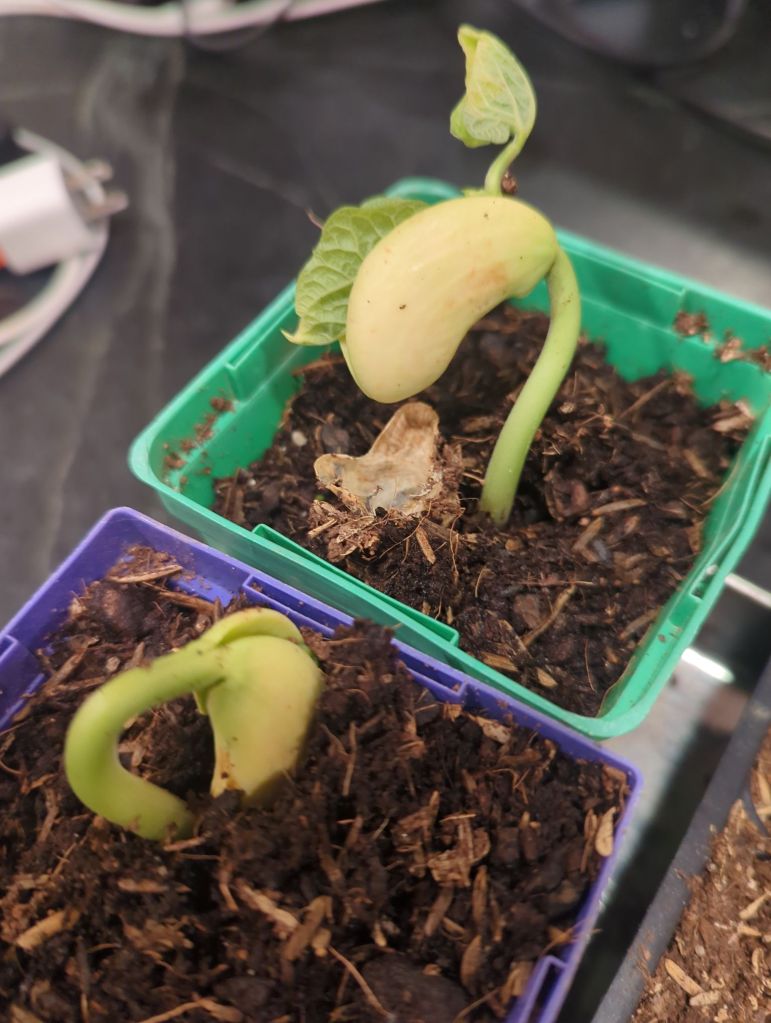
And since then an every day miracle is unfolding on my kitchen window sill. In just a few days, three lima bean seeds burst upward, out of the warmth and moisture provided by the useful repurposed plate warmer below and plastic wrap above, throwing potting soil aside to head for the sky.

The seeds were a couple years old, the Christmas gift from a cousin, and the great-great-great- grandchildren of lima bean plants that my father In-Law grew. Every year he harvested lima beans, Doc Martins, and put them in the freezer. Every Thanksgiving we ate them. The year he died, my husband and his brothers found a harvest in the freezer when cleaning out his house, and had a feast.

But old seeds was not an issue.  After a boring week where I gave them up for dead, and figured it was too late, and nothing was ever going to change, the soil split open A thick stem emerged, bent over, as if gathering pressure to flng itself into the sky. With a giant seed like a lima, you can see every change, and once begun, they expand hourly. Wow!

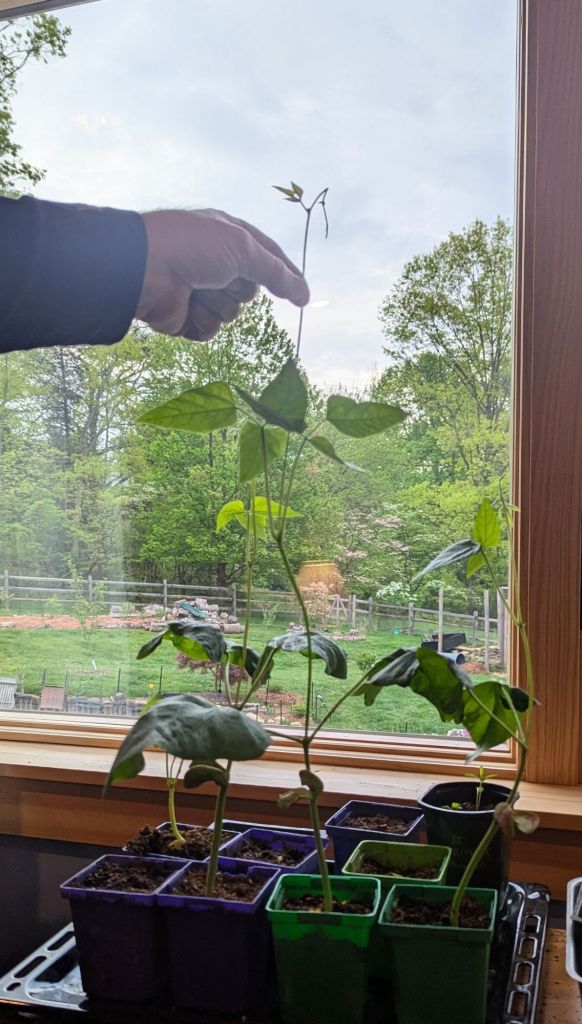
I have done this before, so I know it ain’t that easy. Keeping seedlings going without them drying out, or getting too wet and succumbing to mildew, or stalling and not growing, or growing too fast and going all leggy before the transition to the gardens, can be tricky. It’s work.

So, is it really worth it? You can just buy Lima beans.

But Jack knew about magic beans, and I do too.

I feel a call deep in my being to grow food, and I don’t know why. I have plenty to do. It is unnecessary. Did I get farmer genes from some ancestor? Perhaps I was always going to be like this, coming down the birth canal myself dreaming of chickens and eggs, and growing my own food. Or maybe I learned it from my professor father who used to start trays of seeds in the tiny utility room of our home. I remember his tiny quirky script on the labels, “cosmos,”  “zinnias,” “ageratum.” These he transplanted into a garden of heavy clay he called the fertile crescent. Eventually he gave up, and grew roses exclusively. But he never taught me to bring food out of the ground.

Whether it was nature or nurture, when I married I discovered the magazine Organic Gardening and that childhood fascination swelled and grew within me, putting down roots in my life.  Inspired by my husband and his dad, our gardens expanded, our compost piles multiplied. I kept bees, and then laying hens, and then meat chickens! I put up applesauce and canned salsa.  My mother would have been horrified. I don’t seem to get tired of learning how to grow things.

Often I have been too ambitious,  my ideas grown wild and leggy, over-spilling their pots, and climbing the walls of my mind. If not pruned, they can strangle me.  But I have learned something in 61 years. I know that a little gardening is so good for me, and that a little is enough. If the electrical grid were to shut down, as it did Spain and France did this week, and the supply lines broke, and we had suddenly to grow our own nourishment, I am ready.

But until then, and for the rest of my life, I will continue to put at least a few seeds into the soil each spring, and marvel at the magic.

Ready for the garden!

First Child

Sweet Potato Slips

As the spring slooowly unfurls, taunting us with a few warm days only to plunge us down into the icy blasts, this first child of our garden reaches skyward on my window sill.

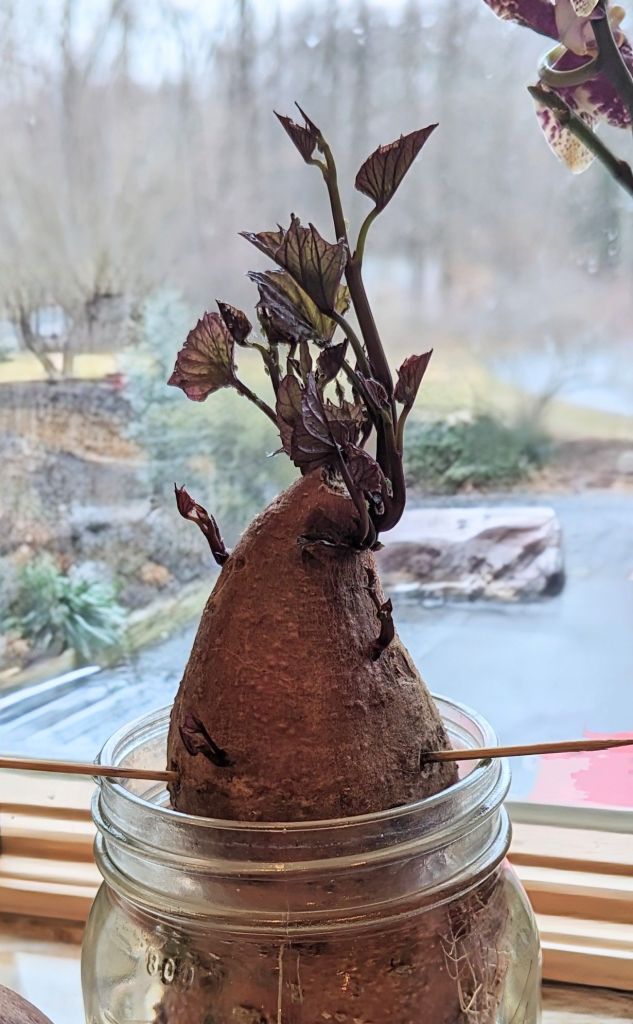
I started the potato soaking in the beginning of February this time, thanks to a note in my calendar. The hardest part of starting sweet potato slips is identifying which end is the bottom. At first I thought nothing was going to happen, so I gave up watching. Sure enough, the tiny sprouts gave way to tall spires and flags flying for Spring.

Unlike white potatoes, sweet potatoes grow from”slips.” White potatoes are planted right into the soil (maybe you have some potatoes in your cupboard now, with scary-looking arms and legs protruding). You mound up the soil on top, and you are fine. With sweet potatoes there is an extra step: the potato grows a slip — and the slip grows new potatoes. I don’t know how that plays out in nature.

You can buy the slips. Or you can grow your own, so that one organic potato grows you a gardenful. In my quest to understand how to create a sustainable food supply for all, learning how to grow my own sweets is a good project. Last year I started way too late. Sweet potatoes are South American in origin– they like heat!! And they need time — 85-120 days of over 65° soil and bright light. You can find videos online to guide you through the process– that’s what I did. Can’t wait to plant them and see what happens

For now, they will climb happily up my kitchen walls…

Thistling

I wanted a wildflower garden…but not this wild.

Our neighbor walked by and observed that there have always been thistles on this property. For decades. Have I considered chemicals?

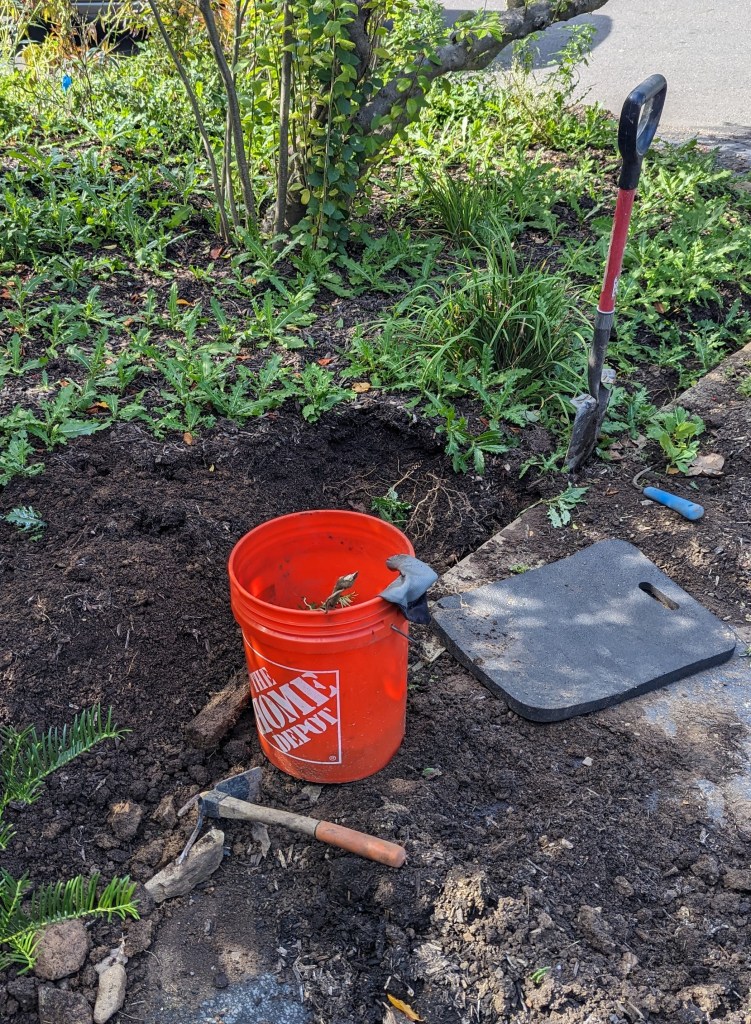
All summer we have battled these thistles. We tried weed-whacking them. We tried cutting them off at ground level with scissors — exhausting. A gardening expert back in MD told me that this weakens the mother root. We got fed up and just pulled them out — that’s pretty satisfying. We tried a side by side comparison, pulling half the bed, and chopping the other side. It was a prickly draw.

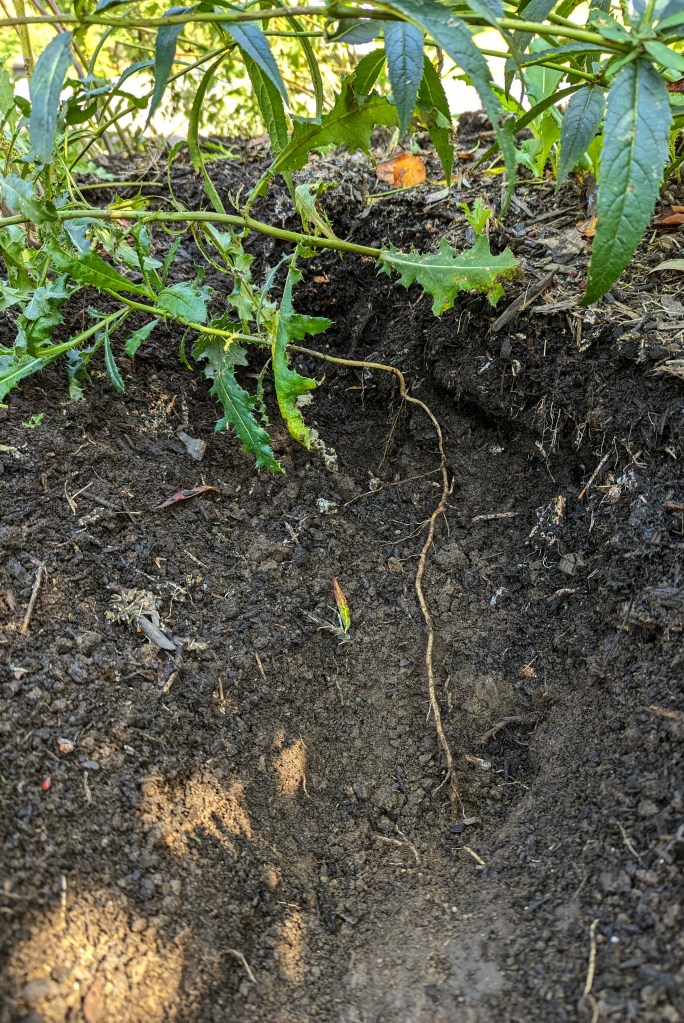
Earlier this summer, I felt victorious if I managed to dig down and pull out nice a long 6-10 inch length of thistle root! But Edward observed that the crafty thistle has evolved to release the upper portion while gripping the soil with a thicker cork screw of residence. Fooled you, sucker.

As I work my way down each deceptively frail looking thistle root… back and back, past the corkscrewing segment that keeps it anchored in the ground…deeper and deeper into the soil, in between the other plant roots, stones, sticks, I am incredibly glad to have a partner in this project. Edward is a lot faster at this. I am more vengeful– I pursue that tap root deeper. After an hour I have only a couple weed-free feet to brag about.

The corkscrew segment of a thistle root

On my knees, deep in soil, I have been thinking of my archaeologist friend Susan. She digs in the dirt for fun. In Ireland mostly. Sounds cold, but at least you get Irish beer.  As I try to trace which tiny root belongs to thistle or another plant, I’m about ready to call in the archaeologist’s trademark tiny brush and pick. This root is heading straight down, like a whale fluking. I will not give up. I want this plant’s lineage. I want its name, rank, and serial number. I’m going to rip out every single blasted speck of root so I never do this again—

Down and down, 20 inches and counting

But I will probably have to.

Research I’ve done on eradicating thistles is pretty depressing. All sources seem to say the only real way to get it done is dig down and dig sideways finding all those little roots. During my enthusiastic excavation efforts, I lifted up an enormous root. Thinking it was The Root, I chopped it in half with a mighty whack! I pulled out the tail with satisfaction!  Then I learned it was actually the tree root of a friendly winterberry.

I definitely considered the blowtorch option – a flame weeder. Handheld weed eradication! “Chemical free!” But our horticulturalist friend Rich says although tempting, it’s a very bad idea. He tried a flame weeder. It took 2 years for that garden bed to recover. High heat doesn’t do much for the Good Guy soil bacteria, fungi and critters that make gardens grow.

I am not tempted by the Roundup fix, not only because I am no cowboy. Years ago we succumbed to the glyphosate temptation to manage a terrible weed problem. So we added more poison to the ecosystem. And the terrible weed was back in 2 years. Round Up is no solution, just pollution.

The wildflower garden is looking great. Buried under the thistles I uncovered flowering perennials that I had forgotten I put in last year. Now rearranged, with the taller stuff in the back, I can’t wait for spring to see how this garden will look, at least temporarily thistle-free.

Just Let It Bee

Mason Bee
(photo – Wikipedia Commons)

Have you ever been eyeball to eyeball with a passionate scientist? You will find it hard to forget. I made the mistake of asking my niece, a research scientist with a double doctorate, about her research on bees at our last family reunion. I got an earful. She had nothing but scorn for the Save the Bees movement. It turns out honey bees are actually bad guys. Killers. Oops. The first thing apis meliferra does in a new environment, my niece told me, is to search out and wipe out the local competition.

It turns out the ones that we gardeners should be worried about are the mason bees, bumble bees, solitary bees, sweat bees, tickle bees — and many other native wild pollinators. As far as crop pollination, guess what, our native guys were already doing the job just fine without the sticky invaders from the east.

From Bees In My Backyard, Facebook

But who am I to point fingers? The honey bee came over with the rest of us Euro-trash, enslaved to our appetites, to provide that lovely sweetness that we all adore. Honey bees are take-over kind of animals… like the European colonists that transported them.

Which is why every time I see “save the honey bees” slogans this I have this “ouch” feeling — that this is yet another example of well-intentioned, zealous half-knowledge. A groundswell of compassionate and passionate planet-savers gone wrong. But then is it actually compassion? Let’s face it, if those European upstarts didn’t make HONEY…would anyone be all fired up enough to sell warm yellow merch?

I love complexity. It’s beautiful to me. The idea that there are layers of insect civilizations doing their jobs, unknown and unseen by most of us buoys up my spirits. How many other things do I not know about what’s happening in my garden? My life? I like to find out how blind I am, and be made to see.

Next summer I am putting in a mason bee house, and building a wildflower garden. All kinds of native plants…which in my area require protection from the deer, since deer selectively eat native plants, instead of eating the pesky plant invaders from foreign parts!… But that’s another story.

Life is rich. Complex. Buzzing.

https://www.nwf.org/Magazines/National-Wildlife/2013/Native-Bees-Slideshow

Seed

The Christmas tree has faded, jettisoned on the blueberry bed, composting itself.  (When it isn’t rolling into our neighbor’s yard pushed by roaring winds.) The strings of lights are finally down and boxed. Even the Christmas cards full of smiling friends are tucked away. Why does it always feel darker after the holidays, even though the days are shorter? But fear not — just grab your potting soil.

With snow flurries and bitter winds boomaranging us back into winter this week, I am a thoroughbred pawing at the starting gate. Too many times before I have been fooled by late cold! Too many times have delayed and missed the beginning of the Growing Season! But not this year.

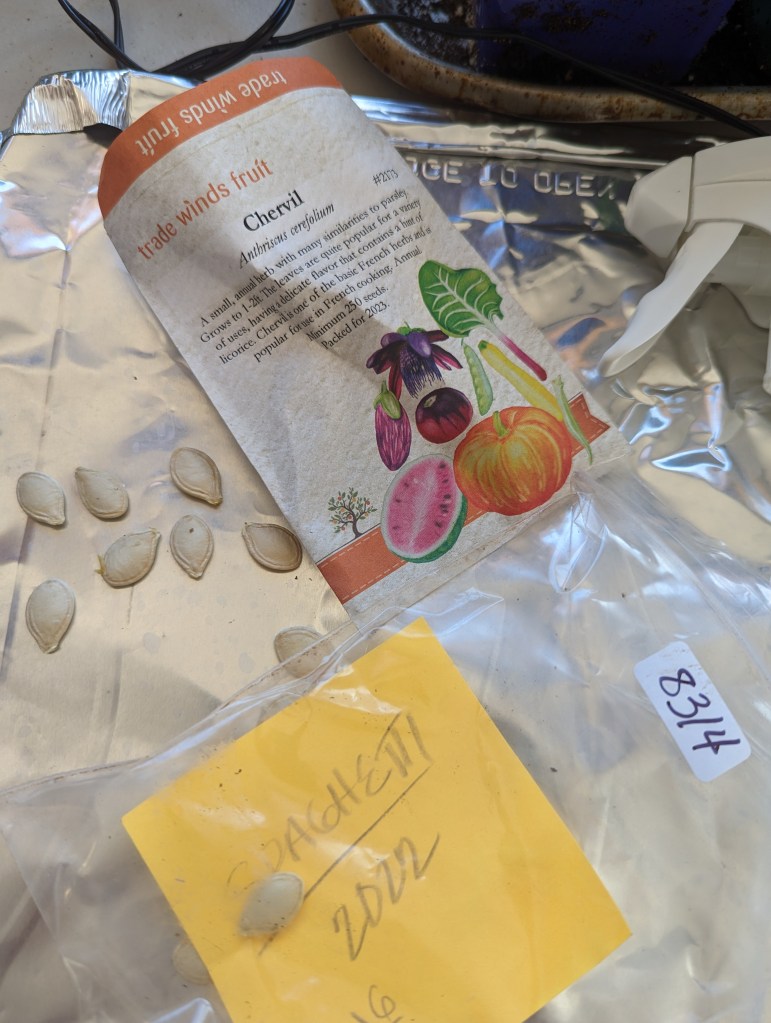
Hiding behind the plates in my kitchen cupboard all winter long were seed packets. Nebula Black Carrots & Atomic Red Carrots, Deer Tongue Lettuce. Chervil. (“Parsley-like”) Heirlooms purchased months ago, impulsively, inspired by rereading Barbara Kingsolver’s classic Animal, Vegetable, Miracle. Seed that I dried and saved from a particularly nice butternut or kobucha squash

My first trays got started in early February — tomatoes, brave onions, and hopeful peppers (peppers are picky– they want their native heat and moisture to germinate). At first I despaired of success. But then I found my old friend, the plate warmer given as a wedding present by a lovely lady who might be shocked at its current employment. And look– magic!

Heating pad below and plastic lid above coaxed peppers into the light!
A pepper seeding enjoying his tiny hothouse environment

This year I continue my quest. I want to discover: how much food can we grow in moderate sized gardens, with moderate effort? We all know gardeners with remarkable plots who are growing everything. They are an inspiration and a barrier to giving the garden thing a go. Not everyone has that time and energy. So, what can my 59year old self produce with a reasonable amount of time and without going into manic mode? What is the sweet spot between the work of growing and the expense of buying good food?

Garlic, thrown into the ground last October, standing up bravely against the March snow

Food prices have risen sharply. There will be pressure on farmers to produce food cheaper. What can this pressure result in but cheap food? Here’s my question: why do most Americans think that cheap food is a good idea? Consider: you put it in your mouth. Why would you put something cheaper, lesser, poorly grown, in your mouth? Don’t blame America’s farmers! They will grow whatever you will eat.

The idea that people will resolve their cost of living issues by eating cheap, chemical saturated food (chemically propagated, chemically fertilized, chemically sprayed) weighs heavy on my heart. All those babies and children eating toxic Cheerios… (Read up on residual Glyphosate in Cheerios here ) We don’t know for sure what this does to them (although some of us have a pretty strong suspicion). These young ones are the guinea pigs, the test cases.

However, I’m also not interested in hauling beautiful organic food in from across the country and around the world to answer my organically grown preferences. All those taxpayer-subsidized truckloads and planeloads full of organic salad (and not organic salad!!) greens. My goal is to eat local as much as possible, grow some of what our family eats, and eat moderately of foods from far away places. I don’t want to get ridgid about it. It’s fun to eat things from other places. But our local farmers need us to buy from them, if they are going to stay in business. And local food tastes so much better.

Lucky for me “Dave’s Backyard Farms” is just down Huntingdon Pike From my house. From there I eat whatever my local growers are producing right now. The meat is so good. The eggs are fantastic, with dark orange yolks. The rubber banded bunches of kale are delicious, the loose carrots SO good.

But I long for everyone to be able to eat sustainably grown, clean food. To make this happen, you got to take back your yard from that boring old lawn. Or, your gotta find some land. Don’t wait for what you need to eat to find it’s way to your regular grocery store. Don’t wait for the FDA to protect your produce, or get hopeless about the high cost of good food. Begin your own revolution! Tis the season….

…and it all starts with seeds.

Meet you in the dirt!

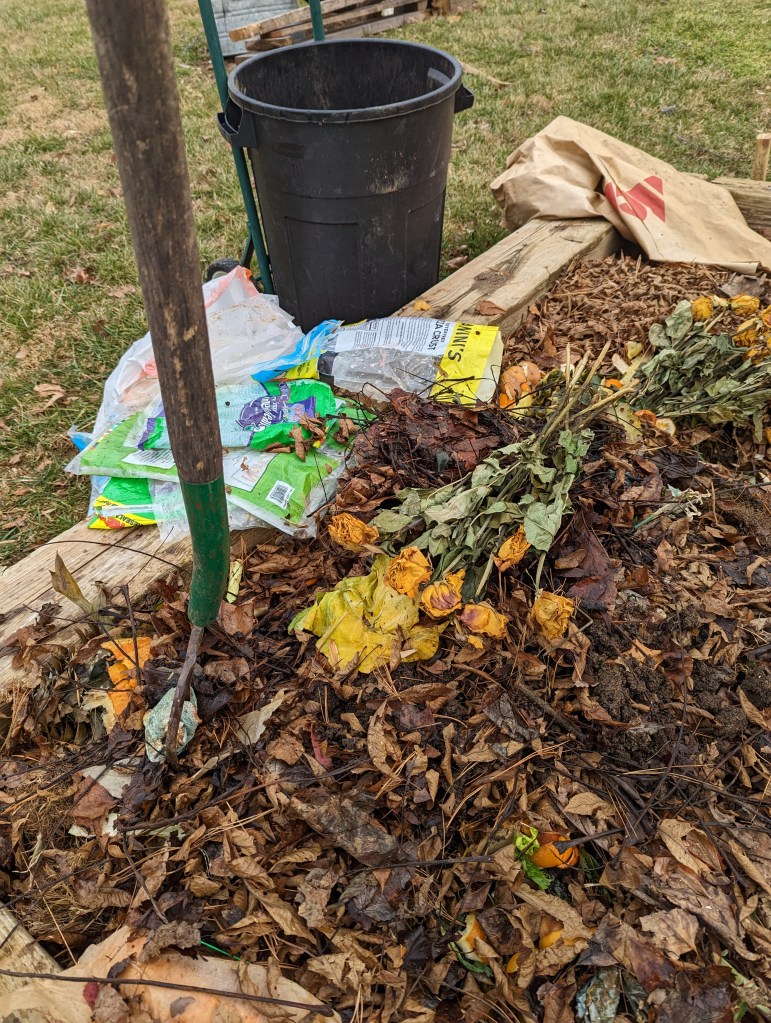
One of the author’s many compost(ing) piles…

Cauliflower Pizza

Romanesco Cauliflower

Spring is about to spring, but it ain’t here yet. This is still the season for winter vegetables, and even those are hard to get if you’re eating local grown…

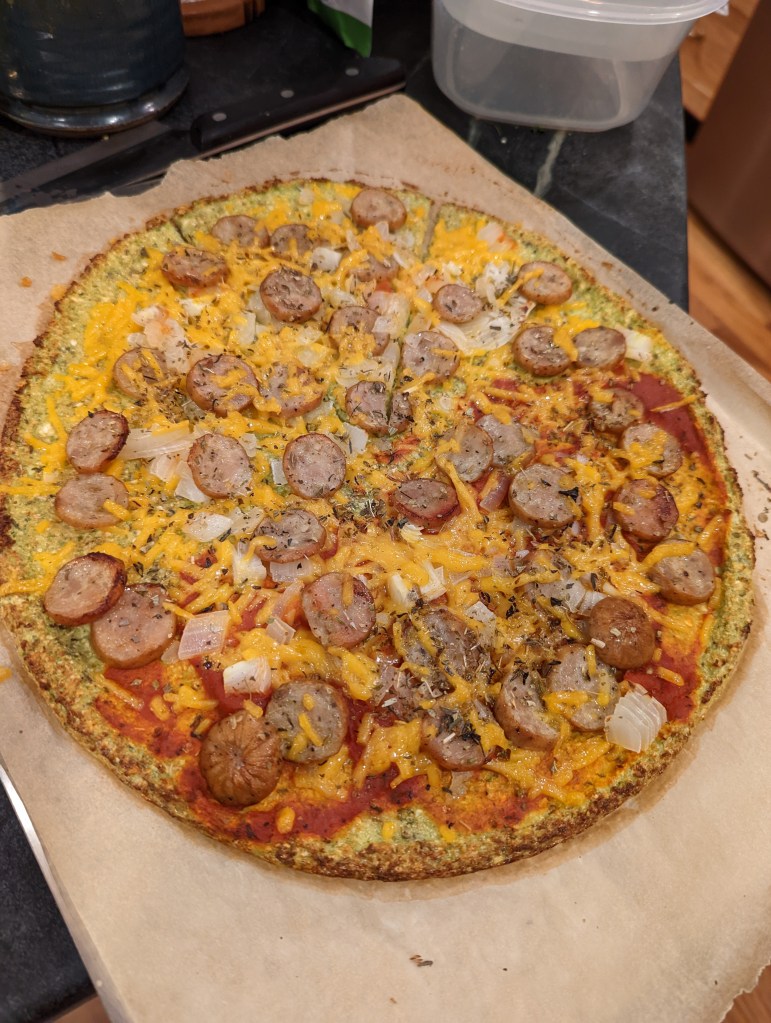
This is a recipe for cauliflower pizza that I discovered and we really enjoyed this winter. While you start your seeds and nurture them through the remaining cold weeks and months, stir up a little evening pizza. This is grain-free, dairy-free if you use vegan cheese, and delicious. Possibly better with a tiny bit of gluten-free flour to thicken things up. Bon appetit fellow gardeners! Here’s to lengthening days. ♥️

Chop
Pulse. Then cook just a minute.
(Missing a sauce pan photo…)
Squeeeze out water.
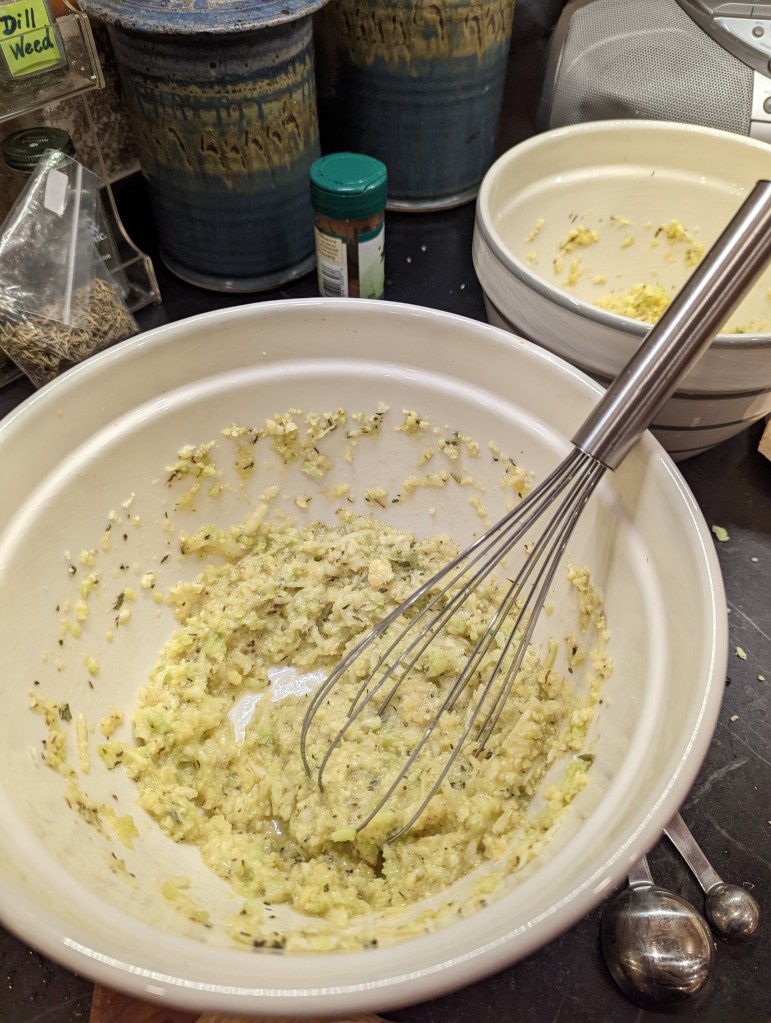
Mix w eggs etc

Recipe swiped from “Oatmeal With a Fork”

Dairy-Free Cauliflower Pizza Crust

My Note: this is very heavy egg content- also very wet – maybe better if 1Tbsp gf flour were used, and less egg??

Ingredients

8 ounces chopped cauliflower florets about 1 tightly packed cup of ‘riced’ cauliflower

½ cup water

1 large egg

⅛ tsp sea salt

½ tsp Italian seasoning

Instructions

*Make your cauliflower rice: grate the pieces using a cheese grater or pulse florets in a food processor until finely chopped.

*In a small saucepan, bring the water to a boil.

Add the cauliflower rice to the pan.

     Turn the heat off (leave the pan on the burner), and cover the pan.

      Let the pan sit covered for 10 minutes.

Preheat the oven to 400 degrees.

*Remove the lid from the ‘rice’, and dump into a clean dish towel. Squeeze the excess water out (there will be quite a bit!).

In a bowl, mix the egg and seasonings & add in the cauliflower. Mix well.

Pour onto a parchment paper-lined baking sheet.

Spoon & spread the mixture out into the shape of a small, round pizza ( about 1/3 of an inch thick). Create an edge crust, if you like.

Bake the pizza crust for 25-30 minutes or until lightly golden.

Remove it and add toppings.

Bake for 6-8 more minutes until toppings have cooked through.

Remove the pizza, cool, and enjoy!

As the Weather Outside Grows Frightful..

Olive tree

The weather report said two nights of low 30s, and we figured it was time. So in come the potted lemons and caldomin oranges, the olive tree and friends. For the next few months they will only huddle and peer out at the brick pathway along the house’s south side, where they basked all spring, summer, and fall. Hopefully they are beefed up enough to survive the spider mites and scale that trouble them in dry indoor heat.

Just look at how they grew! Bodacious! We humans may be challenged to share space with some of our potted friends. Hopefully lemons and oranges are to follow. And although the produce is safe from munching birds, I may still have to net these indoor trees to get my fair share. Owen has sharp eyes, and often gets there first.

We have made the decision to put a small orchard in at the back of the house. Where the rise of land looks south and west should be a perfect spot. This morning I took the plunge, ordering two each of cherries, peaches, and pears from our old friend Stark Bros. I wanted to buy local, but the supply wasn’t there this late in the season.

Edward already planted a fig. We are waiting for delivery of blueberry bushes. The blueberries we did find local (Dimeo Farms, in New Jersey) and organic, for a good price too. I still want to find kumwats… I am dreaming about a variety of citrus that is winter hardy. I want food independence! And I want local, organically grown! So in spite of creaky knees and aging backs, Yes, we are returning to Suburban Growing our own food.

The decision is comforting. After all the uncertainty, all the struggles to make this Pennsylvania house clean and mold-safe, it looks like we are staying. We will always have to be careful with the house’s humidity levels, and cleaning, but more each month we are nestling in, and putting down roots. Thankfully.

The favorite winterberry